Chargement… / Loading…
The project
Overview
The Forest Investment and Savannah Restoration Programme (PIFORES) aims to improve the management of forest landscapes and strengthen the livelihoods of communities in selected areas. It extends to the Western basin (Kinshasa, Kongo Central, Kwilu) and the Central basin (Kasaï, Kasaï-Oriental, Kasaï Central, Lomami) of the DRC the territorial approaches developed by the Improved Forested Landscape Management Project (PGAPF).
The programme is financed by the International Development Association (IDA), part of the World Bank Group. It is overseen by the Ministry of Environment, Sustainable Development and New Climate Economy, through the Forest Investment Programme Coordination Unit (UC-PIF). The financing agreement was signed on 5 September 2023 and came into force on 1 May 2024.
Component 1Improved land-use planning for natural resource management in the target areas
Component 2Development of agroforestry and value chains for sustainable landscape management and better livelihoods
Component 3Development of a sustainable value chain for energy and efficient cooking
Component 4Improved and innovative approaches to measurement, reporting and verification (MRV) and results-based climate finance
Component 5Project implementation, monitoring and evaluation
ALE AJENLD's mission
PIFORES relies on local NGOs, the Local Implementing Agencies (ALE), chosen for their local roots and technical experience. They carry out the activities of components 1 and 2 at community level.
AJENLD was selected as the ALE for lot 2 (Matadi) of the assignment of ALEs in charge of promoting small-scale community agroforestry systems to reduce land-use emissions in Kongo Central, which comprises twelve lots.
Context and challenges
Engaged since 2009 in REDD+ readiness (reducing emissions from deforestation and forest degradation), the DRC was selected in 2010 as one of the eight pilot countries of the Forest Investment Program (FIP). The models developed in this framework, notably by the PGAPF, have proven effective and are now being scaled up by PIFORES.
In Kongo Central, forests and savannahs are under heavy pressure, in particular from slash-and-burn agriculture, bushfires and wood cutting for energy. Restoring these landscapes while improving household farm production is one of the main challenges the project addresses.
Mission objectives
Depending on market opportunities, the ALE also supports the creation of community processing units (small oil mills, cassava and maize mills, beehives) and helps identify people, including women, who wish to take part in these value chains.
Agroforestry approach
The chosen approach favours small-scale agroforestry systems, designed with households and adapted to their plots. The trees planted improve soil fertility and diversify production, while easing pressure on natural forests.
Restoration
Restoration aims to bring back the ecological and productive functions of degraded land: reforestation, savannah enrichment, protection of regenerating areas and fire prevention.
Local communities
No field activity starts without the free, prior and informed consent (FPIC) of the communities. It is obtained during an information session on climate change, the state of local forests, the project and the support available.
In the field
Timeline
June 2026: contract in force (12 June) and start of services (16 June)
Coordination meetings, activity planning and set-up of the monitoring system.
From 2026
Field visits to identify intervention sites and the communities concerned.
From 2026 (free, prior and informed consent obtained before any activity)
Presentation of the project to local authorities and communities, mobilisation of participants.
CLDs: 80% in 2026, 20% in 2027; PSATs in 2026. September 2026: Nduizi, Lukimba and Kionzo CLDs installed
Setting up or revitalising local development committees (CLD) and drafting simple land-use plans (PSAT).
2026 to 2028, following the growing seasons
Setting up and supporting nurseries, producing the seedlings needed for planting.
30% of the target in 2026 (season A), 70% in 2027, the rest in 2028. September 2026: stump clearing at the Kibonga site
Establishing agroforestry systems and restoration plantations with communities.
Until 31 December 2029 (PSAT facilitation and protected-area monitoring missions)
Monitoring of plantations, maintenance and capitalisation of results.
Results
Targets — not yet achieved
Wording to be aligned with the project's official results framework.
Validated data only
No results have been published yet. Results achieved will be presented here once the project's monitoring data has been validated.
Intervention area
Province
Kongo Central
Landscapes
Hills, savannahs and gallery forests
Beneficiaries
Local communities in the intervention area
ALE Matadi AJENLD works in four groupements around Matadi:
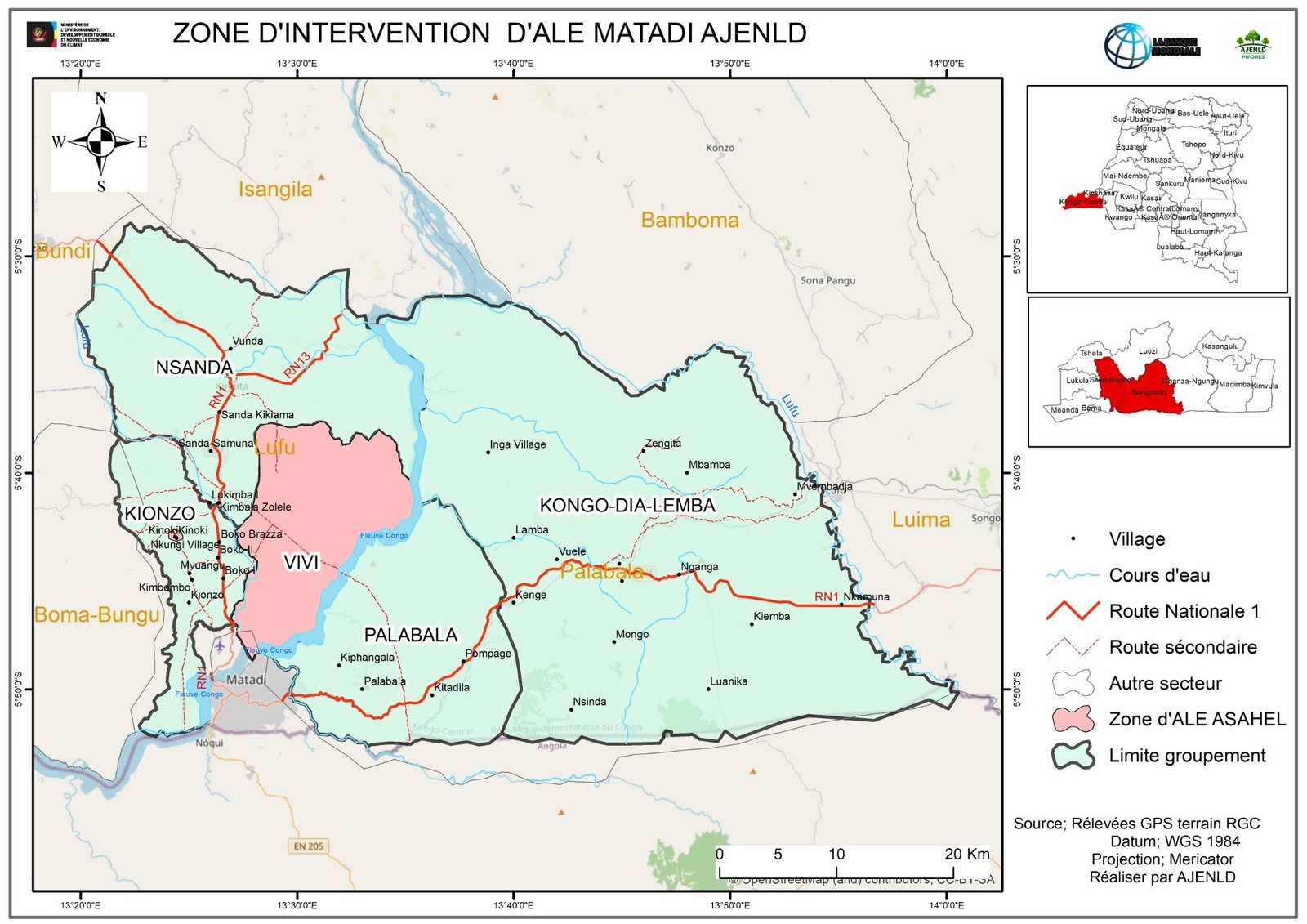 Enlarge the map
Targets set by the ALE's contract for the whole duration of the mission. These are objectives, not results achieved.
4
CLDs set up or strengthened
4
PSATs drafted and registered
700 ha
of acacia-cassava agroforestry
150 ha
of fruit tree and food crop agroforestry
150 ha
of innovative agroforestry
50 ha
of oil palm and food crops
50 ha
of timber plantations
2,500 ha
of savannah and forest under protection (ANR)
Institutional partners

World Bank
Ministry of Environment, Sustainable Development and New Climate Economy
Forest Investment Programme Coordination Unit (UC-PIF)
Follow the project's progress through our activity reports and our photo gallery.